Ethiopia’s Digital Economy: Rapid Growth and Transformation
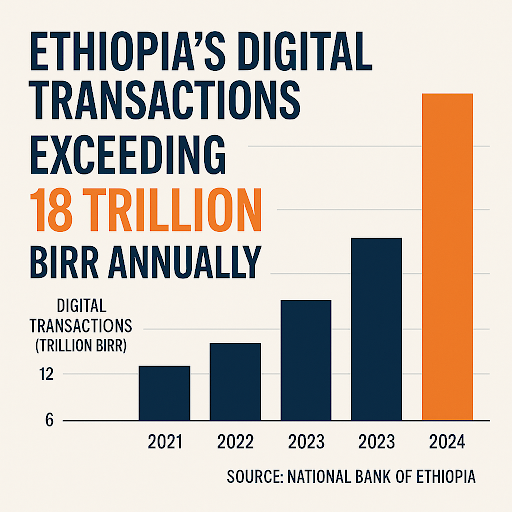
Ethiopia’s digital economy has experienced explosive growth in recent years. According to the National Bank of Ethiopia (NBE), the annual value of digital financial transactions now exceeds 18 trillion Ethiopian birr, which is more than three times the country’s gross domestic product. This stunning figure underscores how rapidly Ethiopians are adopting digital payments and cashless modes of commerce. The surge represents a dramatic rise from just a few years prior for instance, in the year to June 2024, digital payments totaled about 9.6 trillion birr, indicating that the volume has roughly doubled within a year.
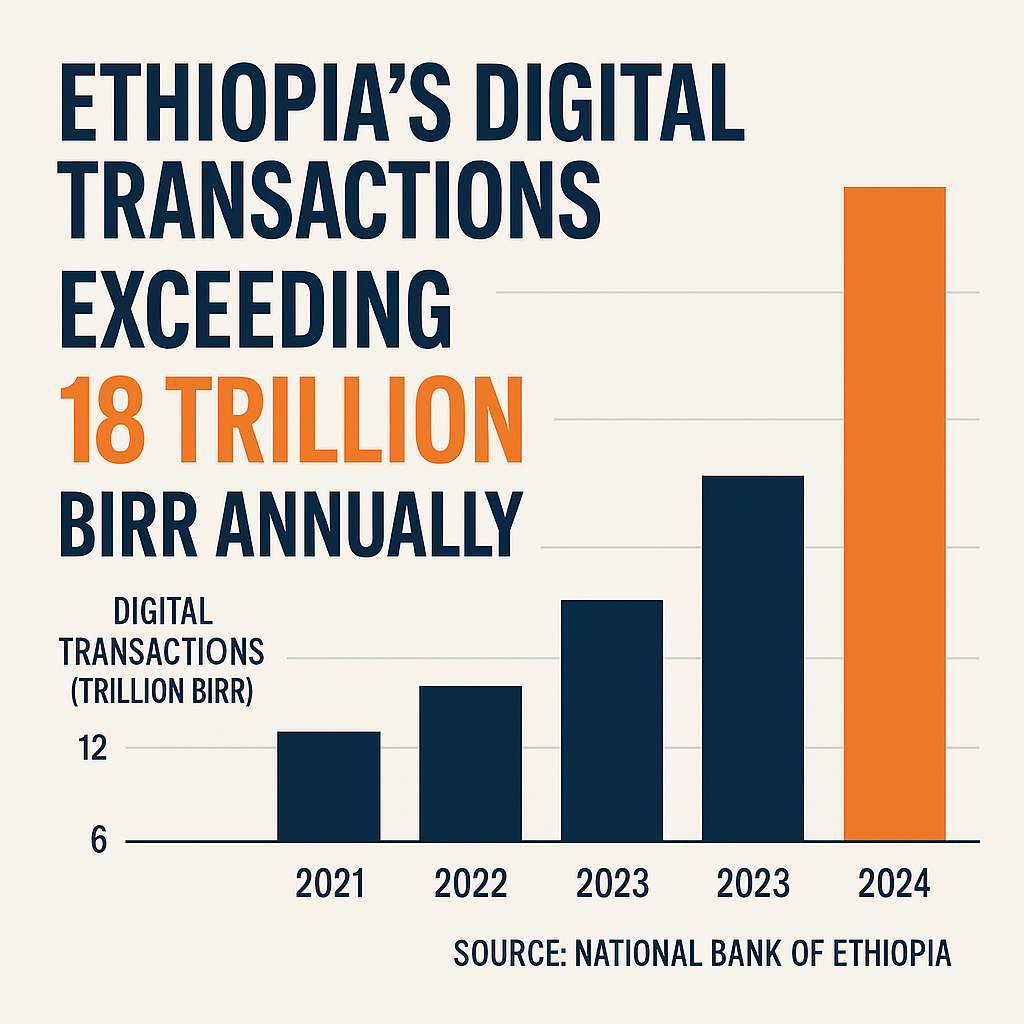
Breakdown of Ethiopia’s 18 Trillion Birr Digital Transactions
- Mobile Money:
- Telebirr: 2.3 trillion birr in FY 2024/25; 4.9 trillion birr cumulatively since 2021.
- Other players: HelloCash, Kacha, and Safaricom’s M-Pesa (launched 2023).
- Accounts: 107M+ mobile money users by mid-2024.
- Digital Banking:
- CBE: 7.7 trillion birr processed in just 8 months (Jul 2024–Feb 2025), ~12–13 trillion annually.
- Share: 79–92% of CBE’s transactions now digital.
- Industry total: 39.6M mobile banking users, 45.5M debit card holders by Jun 2024.
- Other Digital Payments:
- ATMs: 94M transactions worth 119.2B birr.
- POS: 2.3M transactions worth 5.5B birr.
- P2P transfers: 55M transactions worth 283B birr.
- Overall Trends:
- 2.4B+ individual digital transactions in 2024.
- ~70% via mobile money/banking; rest through cards, ATMs, and other channels.
- Digital transaction value now dwarfs Ethiopia’s GDP.
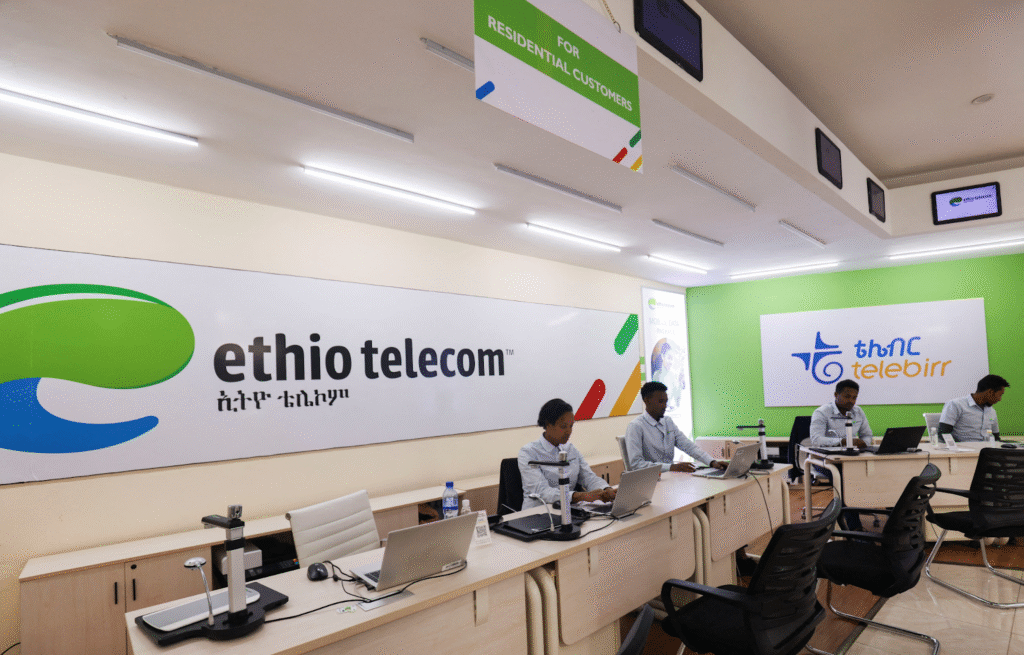
Mobile money is the engine of Ethiopia’s digital finance surge. Telebirr, launched in 2021, rocketed from 6M users in 2 months to 54.8M by mid-2025, evolving into a “super app” handling P2P transfers, bill pay, government fees, e-commerce (Zemen Gebeya), and entertainment.
Competition is rising: Safaricom’s M-Pesa entered in 2023 with ~2M early users, while Kacha became Ethiopia’s first private mobile money provider, piloting services like digital fuel payments. Beyond wallets, fintech startups are building infrastructure: Chapa enables local/international e-commerce payments, ArifPay supports POS solutions, and FenanPay (2025) launched with 0% merchant commissions, linking all banks and offering tools like analytics and Telegram bot payments. Fintech is also driving digital credit & savings: by mid-2025, 24.5B birr in micro-loans reached 11M borrowers. Telebirr alone disbursed 13.2B birr in loans and mobilized 11.2B in savings. In short, Ethiopia’s fintech ecosystem is rapidly maturing – moving from simple transfers to credit, savings, e-commerce, and integrated financial services.
Ethiopia’s digital economy is accelerating as banks and fintechs expand access: the Commercial Bank of Ethiopia now processes 92% of its 12.9T birr transactions digitally, while nationwide access points jumped 64% to over 445,000 in 2024. E-commerce, though still small ($59M in 2024), is growing with platforms like Ethio Telecom’s Zemen Gebeya and new gateways such as Chapa and FenanPay. This transformation is anchored in government strategies like Digital Ethiopia 2025 and the National Digital Payments Strategy, supported by 4G/5G rollout, digital ID, interoperability via EthSwitch, and mandates for digital payments in public services. Yet challenges remain: low digital literacy and trust, patchy infrastructure, regulatory delays, high costs, and cyber risks (Ethio Telecom fended off 462,000 attacks in one year). Inclusion gaps also persist—only about 9% of Ethiopians actively use digital finance despite hundreds of millions of registered accounts—but reforms and competition are steadily pushing the country toward a cashless future.
Ethiopia, with 120–130M people (mostly young and tech-aware), is one of Africa’s biggest untapped digital finance markets. The government’s target of 70% account ownership by 2025 is within reach, and if usage deepens, digital credit and savings could transform livelihoods much as M-Pesa lifted 2% of Kenyan households out of poverty. Homegrown innovation is rising: platforms like FenanPay (0% commissions) show local capacity, while startups in agri-finance, transport, and education can scale quickly on interoperable rails like EthSwitch’s QR system. Public-private partnerships are expanding literacy and infrastructure, and reforms are attracting investors as Ethiopia liberalizes telecom and banking. With 18T birr in annual digital transactions (triple GDP), the next frontier is everyday retail adoption—QR code payments in shops, cafes, and taxis are already becoming common. Challenges around trust, infrastructure, and inclusion remain, but they are being tackled through policy and entrepreneurial solutions. In essence, Ethiopia is having its “fintech moment”: a chance to leapfrog with 5G, digital ID, AI-driven credit, and super-apps like Telebirr. If current trends hold, millions more will enter the formal economy, fueling entrepreneurship, jobs, and growth—making Ethiopia a rising digital finance leader in Africa.
References;
- National Bank of Ethiopia and government reports on digital payments and financial inclusiondigitalfrontiers.orgbetterthancash.orgdigitalfinance.shega.co
- Official statements from Prime Minister Abiy Ahmed and NBE Governor on digital transaction figures and reformsfanamc.comstockmarket.et
- Ethio Telecom annual report and media briefings on Telebirr usage and telecom infrastructure expansionfanamc.comfanamc.com
- Shega Media and Fana Broadcasting reports on banking sector digitization and mobile money user statisticsshega.cofanamc.com
- Fintech news outlets (StockMarket.et, etc.) on new digital payment platforms and regulatory changesstockmarket.etstockmarket.et
- Academic and development analyses on Ethiopia’s digital payments landscape and ecosystem challengesdigitalfrontiers.orgdigitalfrontiers.orgdigitalfrontiers.org.
Michael D. Hailesilase